← The Four Europeans
République Française

Lafayette

Marie-Joseph du Motier, Marquis de Lafayette

Le Héros des Deux Mondes

"Cur non? — Why not?"
Born
1757
Died
1834
To America
1777
Park corner
Southeast corner
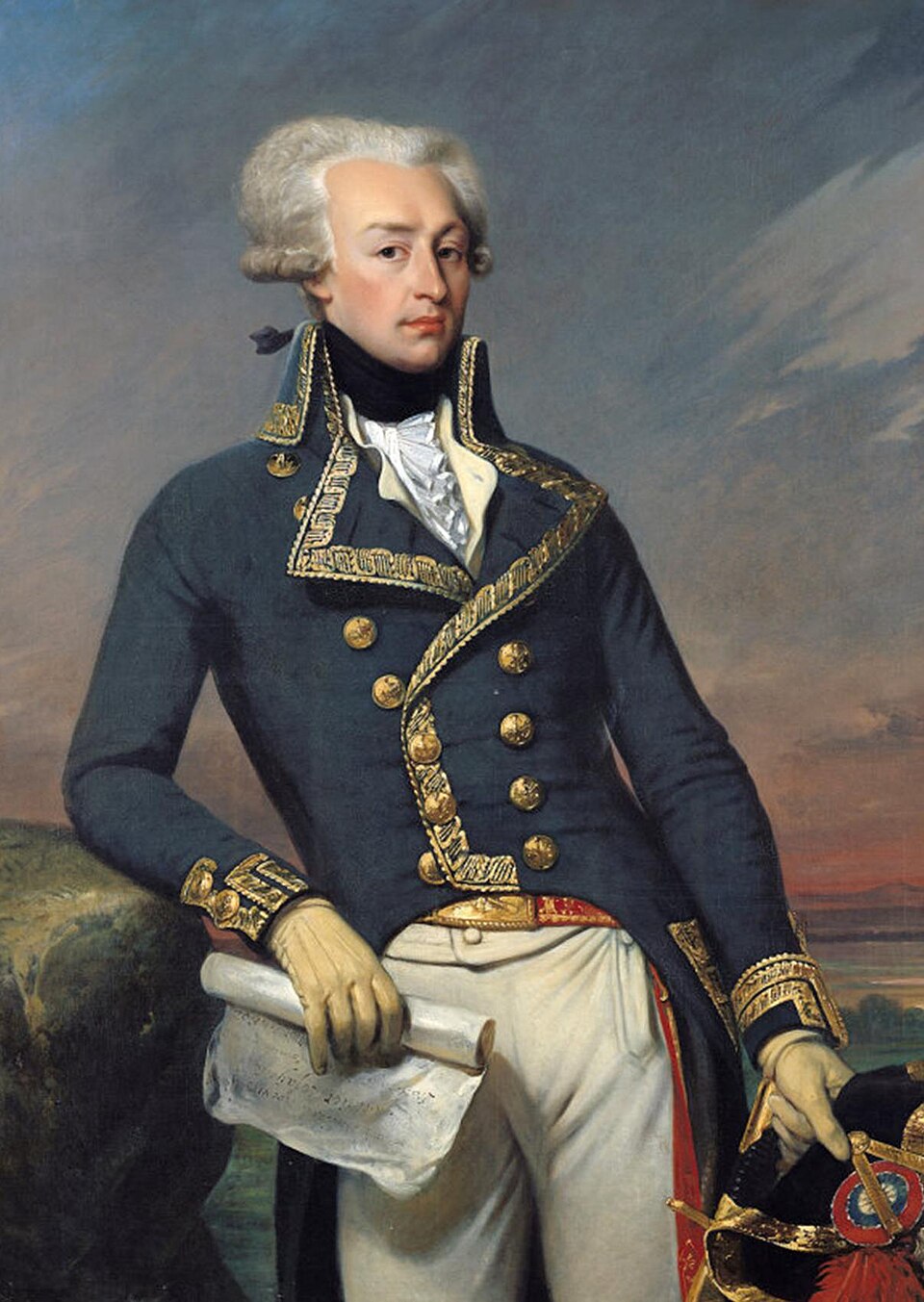
Painted period portrait of the young Marquis de Lafayette in Continental Army blue and buff uniform with gold epaulettes
Gilbert du Motier, Marquis de Lafayette (oil on canvas)Public domain via Wikimedia Commons, https://commons.wikimedia.org/wiki/File:Gilbert_du_Motier_Marquis_de_Lafayette.jpg
Key Contribution

The Franco-American Alliance Made Flesh

A teenage marquis whose presence in Washington's tent turned a colonial rebellion into a Bourbon-backed war.

Lafayette's voluntary service, family connections at Versailles, and rapport with Washington helped convert French sympathy into the formal 1778 alliance, the Expédition Particulière, and the joint Franco-American victory at Yorktown.

BrandywineMonmouthYorktown

Content forthcoming.

A Life in Time

Interactive Timeline

Auvergne, France
1757

Born at Château de Chavaniac

Military Role

French aristocrat, Continental Army major general, symbol of Franco-American friendship

Content forthcoming.

Political Ideals

Constitutional monarchy then liberal republicanism; natural rights, religious toleration, gradual emancipation, and a tricolor patriotism modeled on what he called 'the American example.'

libertyrepublicanismyouthidealismtransatlantic revolution

Three Memories

How one life was remembered on three continents.

In America

Why Americans remembered him

Remembered as the adopted son of Washington and the embodiment of disinterested foreign aid. His 1824–25 tour produced a flood of Lafayette towns, counties, streets, and place-names — a civic liturgy of the early republic.

Content forthcoming.

In Europe

How Europe remembered him

In France, Lafayette is a contested figure: liberal hero of 1789 and 1830, distrusted by Jacobins and royalists alike. The tricolor cockade he helped popularize remains the visual grammar of the Republic.

Content forthcoming.

In the Diaspora

Immigrant memory

For nineteenth-century French émigrés and twentieth-century Free French alike, Lafayette was the passport. 'Lafayette, we are here' (1917) made him the patron saint of the Franco-American moral debt.

Content forthcoming.

The Biography

Biography

Born to one of the oldest military families of Auvergne, Lafayette inherited a fortune, a title, and a haunting absence — his father fell to British guns at Minden when the boy was two.

[Citation: Unger, Lafayette, 2002]

Sources

Bibliography & Image Credits

Bibliography
  • Unger, Harlow Giles. Lafayette. New York: Wiley, 2002.
  • Lafayette, Marquis de. Mémoires, correspondance et manuscrits du général Lafayette, vol. I. Paris, 1837.
  • Levasseur, Auguste. Lafayette in America in 1824 and 1825. Philadelphia, 1829.
  • Content forthcoming.
Image Credits
  • Gilbert du Motier, Marquis de Lafayette (oil on canvas) — Public domain via Wikimedia Commons, https://commons.wikimedia.org/wiki/File:Gilbert_du_Motier_Marquis_de_Lafayette.jpg
Continue the exhibit

The other three